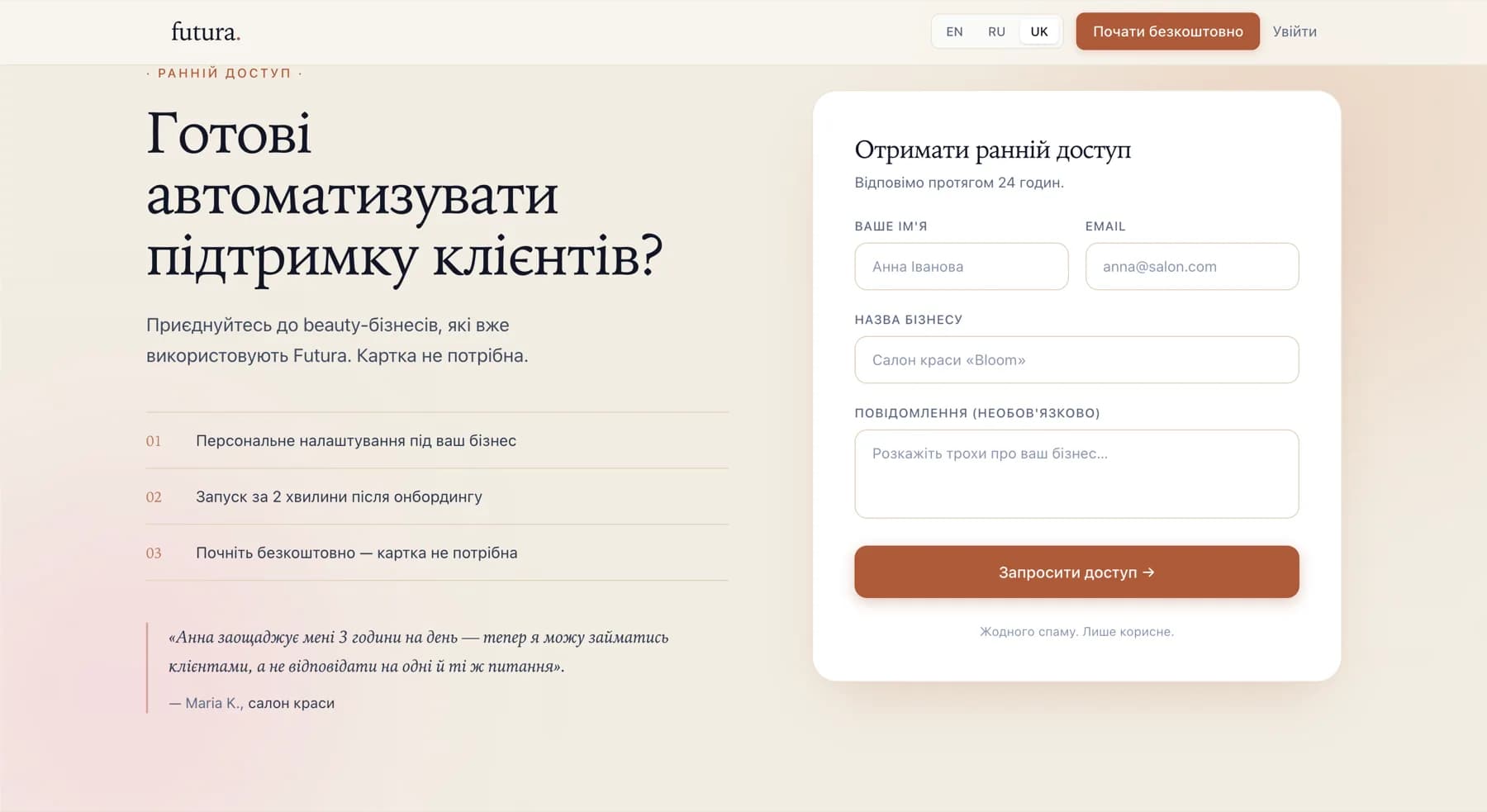
Futura AI — own SaaS product · 2026
An AI assistant beauty salons embed in two minutes
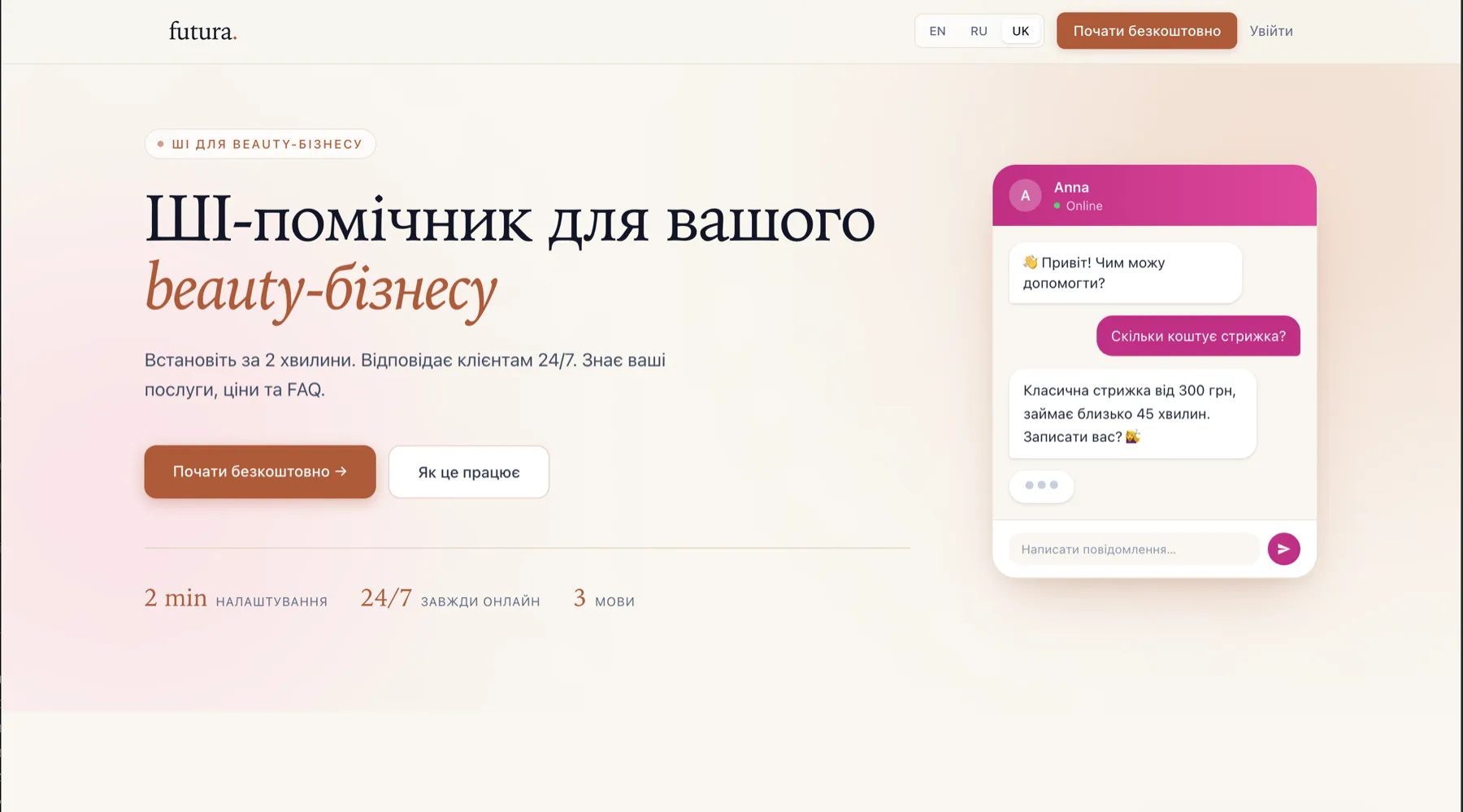
A multi-tenant SaaS: an embeddable AI chat widget that answers a beauty salon's clients 24/7 — a ~3 KB loader, an iframe widget app, a .NET backend, and Claude with retrieval over each tenant's own services and prices.
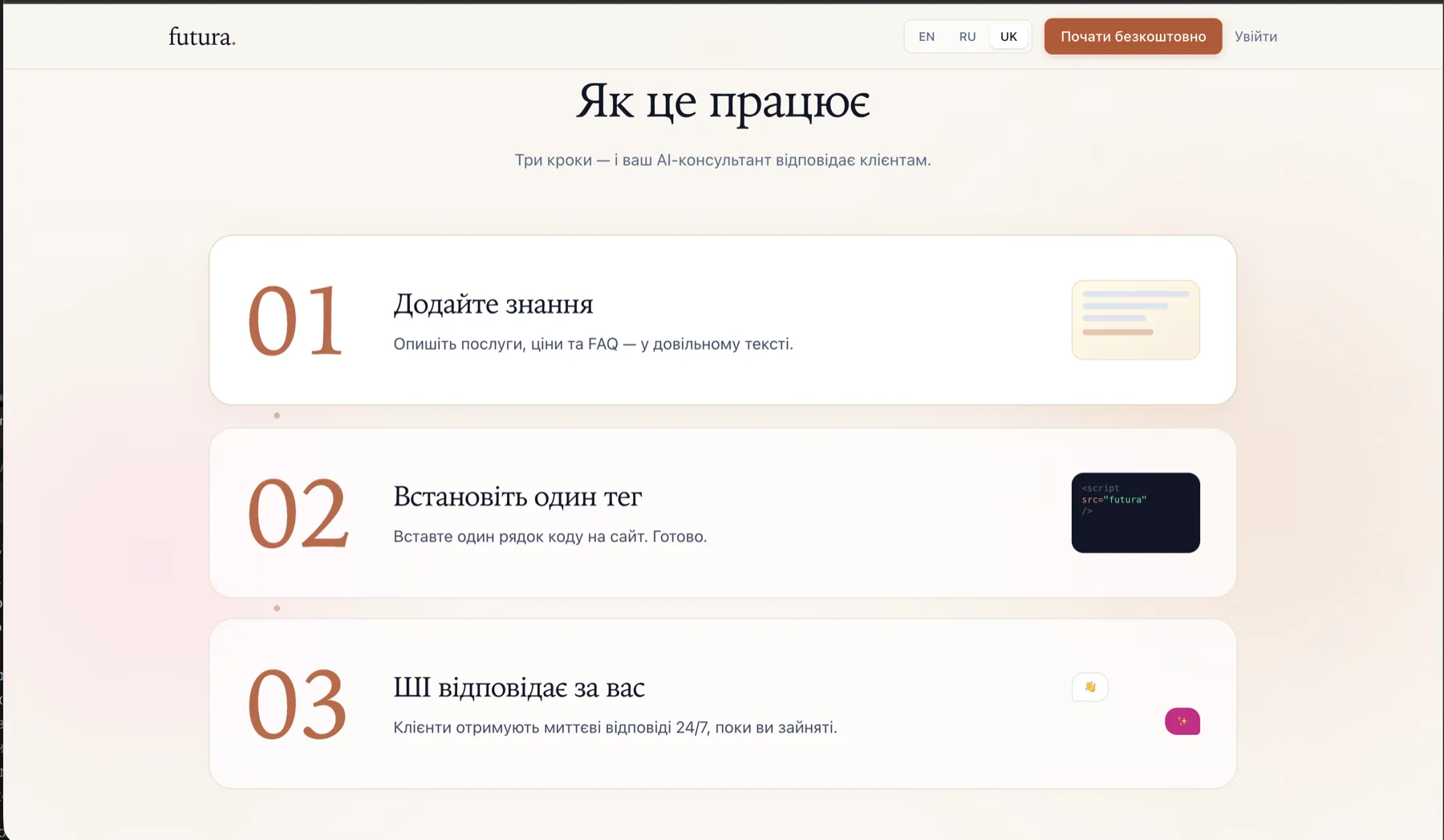
A live product (beautyfutura.com) — salons add an AI assistant with one script tag, no integration work
The problem
Beauty salons drown in repetitive messages — how much is balayage, are you open Sunday, will this work on coloured hair. Owners spend hours answering the same questions instead of doing the work. Off-the-shelf chatbots don't solve it: they're generic, they don't know this salon's services and prices, and wiring one up is an IT project a non-technical owner will never finish. The bar was an assistant that knows the specific business — and that the owner can install themselves.
My approach
I built Futura as a multi-tenant SaaS, in layers:
- A tiny widget loader (~3 KB, IIFE bundle) — the only thing a salon pastes into their site.
- An iframe widget app (Next.js) — sandboxed from the host page's CSS and JavaScript.
- A .NET backend — tenants, conversations and the AI orchestration.
- Claude with retrieval (pgvector) over each tenant's own catalog, so answers are grounded in real services and prices, not invented.
- Multi-tenancy from day one — every record scoped to a tenant, decided in an ADR before the first table existed.
Stack & why
- Embed = loader + iframe, not an SDK — a salon pastes one
<script>; the iframe sandboxes the widget so it can't break, or be broken by, the host site's styles. - .NET 10 clean architecture — Domain / Application / Infrastructure / Api; tenant and conversation rules are real domain logic, kept testable.
- Claude Sonnet 4.5 + Haiku 4.5 — Sonnet for real answers, Haiku for the cheap path. Cost control is a feature when the plan starts at $0/mo.
- pgvector on the same Postgres — retrieval grounded in each tenant's catalog without operating a separate vector database.
- Hetzner for the API, Vercel + Cloudflare R2 for the edge — the stateful backend stays cheap on a VPS; the loader and widget are served fast from the edge.
The result
- A live product at beautyfutura.com — a salon installs the assistant with a single script tag, in about two minutes, with no integration work.
- The assistant answers in three languages (English, Ukrainian, Russian), handles photo and voice messages, and hands off to a human when it should.
- Architecture that scales per tenant: a new salon is a new row, not a new deployment.
What was hard
Two hard parts. First, the embed: a widget that loads on someone else's site has to stay invisible until needed, be immune to their CSS, and stay tiny — hence a ~3 KB loader plus an iframe instead of a heavy SDK. Second, grounding: an assistant that guesses a salon's prices is worse than no assistant. The real work was the retrieval layer — getting Claude to answer strictly from each tenant's own catalog, and to say "let me connect you with the team" instead of inventing an answer.
Related work
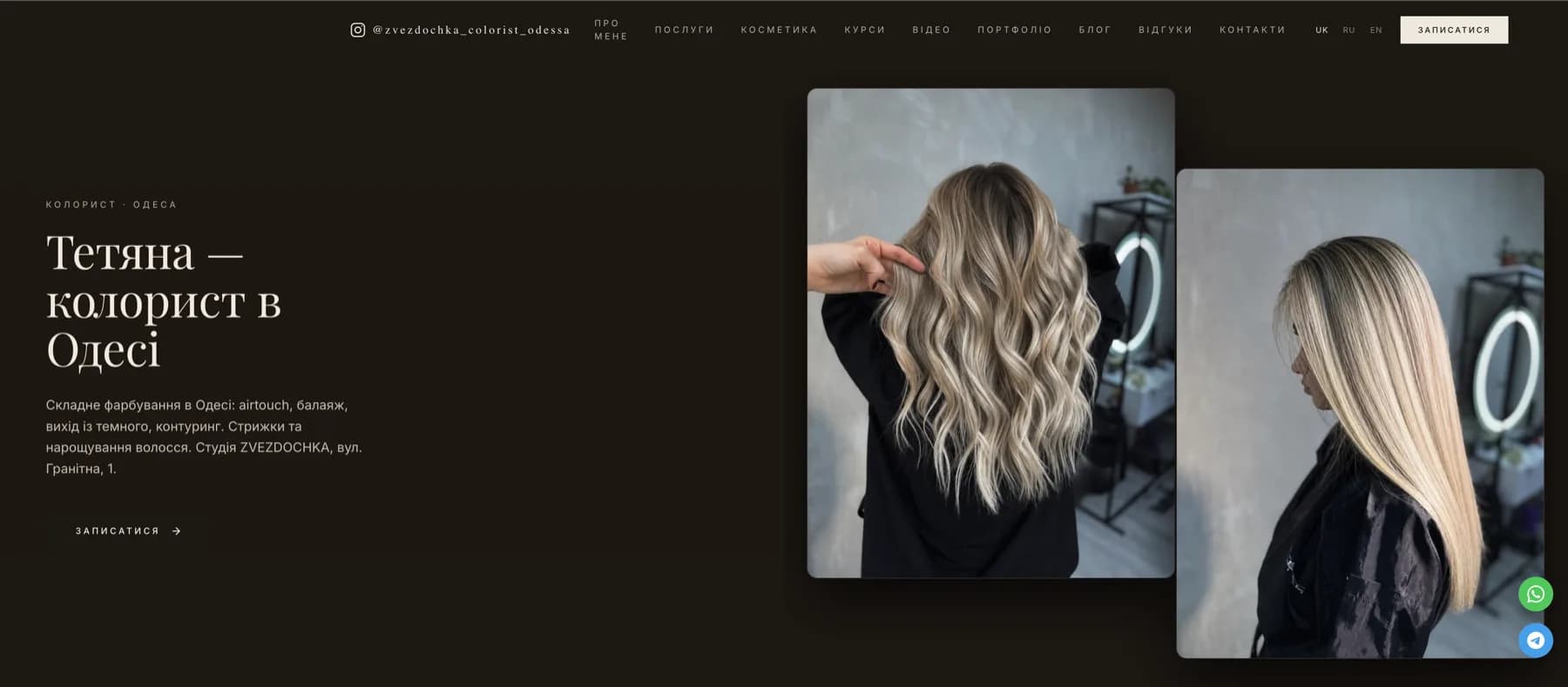
A portfolio site that books clients for a hair colorist
2026Zvezdochka — hair-coloring studio, Odessa
An image-heavy, multilingual portfolio and booking site for a professional colorist — fast galleries served from object storage, reviews, courses, and direct booking channels.
An owned, multilingual home that turns Instagram traffic into bookings
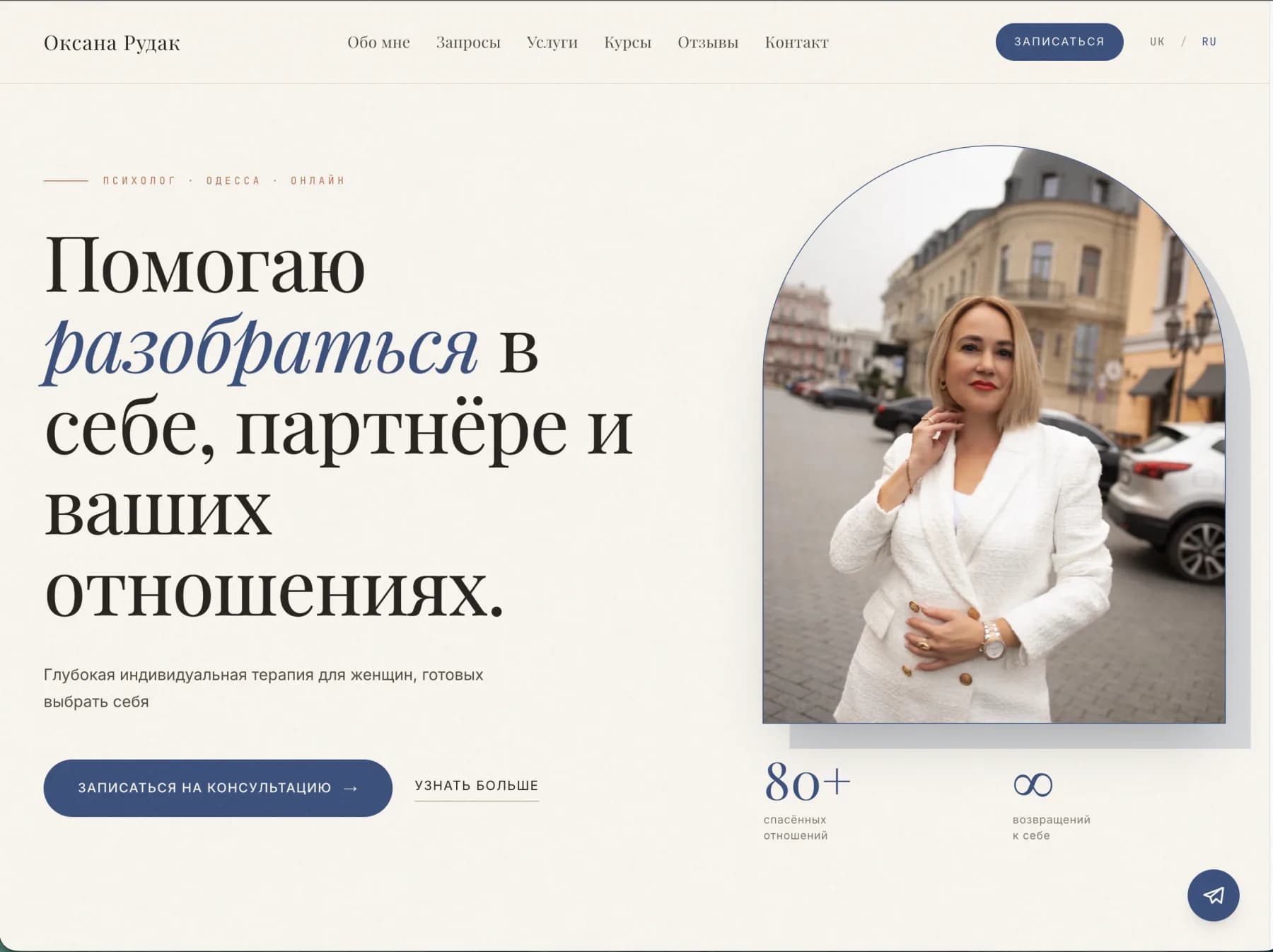
A trust-first site that turns followers into first sessions
2026Oksana Rudak — psychologist, Odessa
A warm, editorial practice site for a psychologist who helps women through toxic relationships, abuse and self-esteem recovery — built to earn trust on a sensitive topic and turn a hesitant visitor into a booked consultation without pressure.
An owned, bilingual home that converts Instagram followers into private first contacts
Want something similar built?
I take on a small number of projects at a time. If this looks like your problem, let's talk.