SaaS development & MVP
From idea to a live product real customers can subscribe to — with the multi-tenant groundwork that decides whether year two is possible.
I run my own SaaS (Futura AI), so this isn't theory. The decisions that hurt later are made in the first weeks: how tenants are isolated, how billing maps to access, whether one customer's data can ever appear in another's account. I build the MVP small but structured, so growth is a matter of adding features rather than rewriting the foundation.
What's included
Multi-tenancy from day one
Tenant isolation designed in at the data layer, not bolted on after the first enterprise customer asks about it.
Subscriptions and billing
Plans, trials, upgrades and failed payments wired to what a user can actually access — including the unhappy paths.
Onboarding that converts
Sign-up to first real value in as few steps as possible. The MVP's job is to prove people will pay, and onboarding is where that's won or lost.
An admin view for you
See tenants, usage and subscription state without opening a database client.
Infrastructure that scales later
Docker, PostgreSQL, background jobs and caching set up so the second thousand users doesn't require a rebuild.
A scope that ships
We cut the feature list to what proves the business, launch it, and add the rest once real users have told you what matters.
How we'd work
- 01
Scope, in writing
We agree exactly what gets built and what it costs before any code — no creeping invoice, no surprises.
- 02
Ship in slices
Working software every week, not a big-bang reveal at the end. You see progress and can change course early.
- 03
Pay after launch
You pay once the project is live and you're happy with it. No upfront deposit.
Related work
Questions clients ask
How small should an MVP be?
Small enough to launch in weeks, complete enough that someone would pay for it. Most failed MVPs are too big, not too small — we cut aggressively and add back based on real feedback.
Why does multi-tenancy matter this early?
Because retrofitting it is a rewrite. Isolating tenants properly at the start costs a little upfront and saves the project later, especially the first time a customer asks a security question.
Can you integrate payments?
Yes — subscription billing including trials, upgrades, cancellations and failed-payment handling, connected to your feature access.
Have you actually built one?
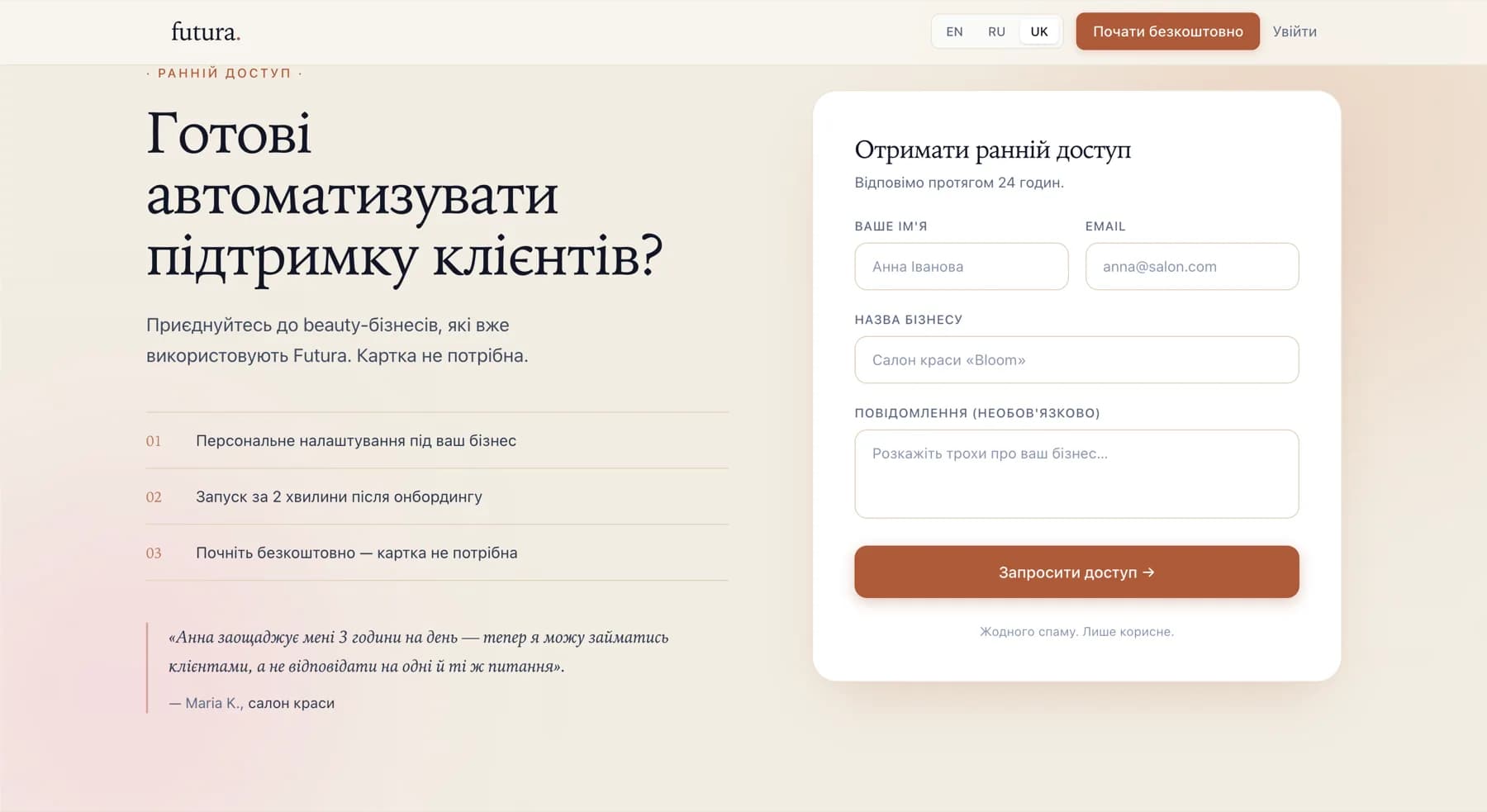
Yes — Futura AI, a multi-tenant AI chat widget for beauty salons, live at beautyfutura.com. Same architecture I'd build for you.
What happens after launch?
I stay available to build the next round of features, fix what real usage exposes and keep infrastructure healthy — for as long as it's useful to you.
Have a project in mind?
Tell me what you're building and where it's stuck. I usually reply within a few hours.